Nomad 3 · Volume 2
Nomad 3 — The Machine in Detail
2.1 Reading the machine as a system
A CNC mill is a stack of subsystems that all have to cooperate: a stiff frame to fight cutting forces, motion axes to position the tool, a spindle to spin it, a way to hold the cutter, a way to hold the work, and a way to tell the machine where everything is. On a light desktop machine, the frame and the spindle are the parts that decide what materials are realistic, and the probing is the part that decides how repeatable the results are. This volume walks the Nomad 3 subsystem by subsystem, with an eye to why each choice was made and what it means for the parts that come out.
2.2 The enclosure and frame
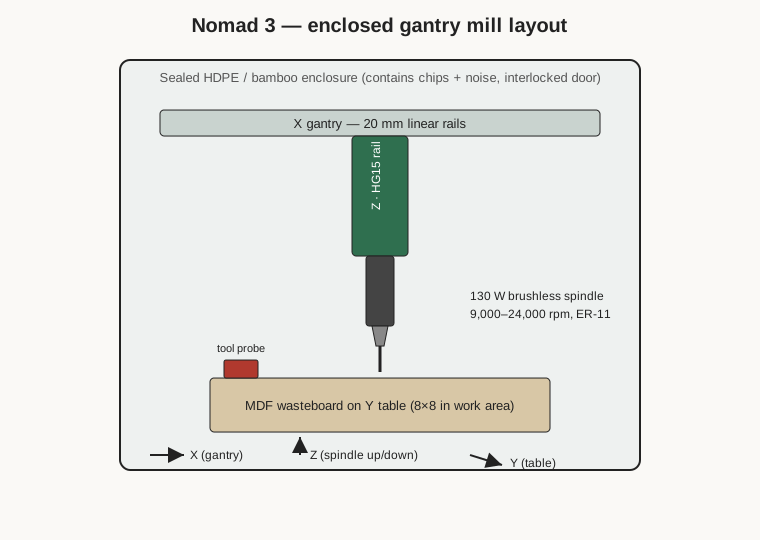
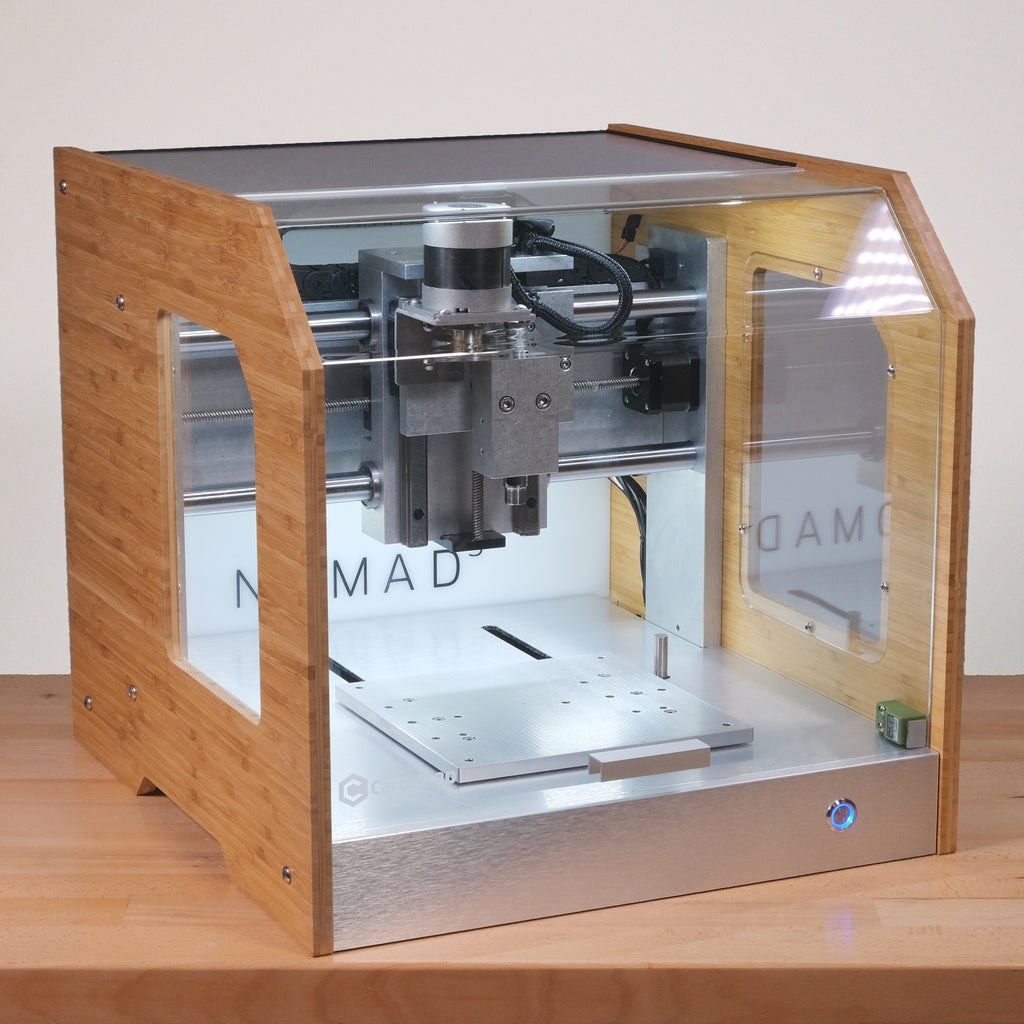
The enclosure is not a cosmetic wrapper; on the Nomad it is structural in spirit and functional in fact. The panels — HDPE or bamboo depending on the version — form a sealed shell around a rigid internal frame. Functionally the shell does three jobs: it contains chips and dust inside the machine’s tray, it damps the acoustic noise of cutting so the machine is quiet enough for a shared room, and it provides an interlocked door so the spindle is not exposed while it runs. Internal LED lighting lets the operator watch the cut through the clear front window.
Underneath the panels, the priority is stiffness. Every gram of flex between the cutter and the workpiece shows up as chatter, poor finish, and lost accuracy, and a small machine cannot rely on brute mass the way a cast-iron knee mill does. The Nomad instead keeps everything short and close: a compact frame, a small work area, and short spans on every axis so there is simply less structure to bend. The trade is obvious and deliberate — you accept a small work envelope in exchange for a frame that can hold that envelope rigidly enough to cut metal.
2.3 Axes, motion, and rigidity
The Nomad is a three-axis machine in a moving-table configuration. The spindle rides on the Z axis (up and down) on a gantry that carries it across X (left and right); the workpiece sits on a table that moves in Y (front to back). “Gantry” simply means the bridge that spans the work and carries the cutting head.
The motion quality on a machine like this is set by two things: the linear guides the axes slide on, and the drive that moves them. The Nomad 3 uses substantial 20 mm linear rails on the X and Y axes — noticeably stiffer than the 16 mm rails used on earlier Nomads — and an upgraded profile linear rail (HG15-class) on the Z axis, which is the axis that takes the most side load when a tool is buried in a cut. Linear rails matter because they resist the twisting and lifting forces of milling far better than the plain rods some hobby machines use; the stiffer the guide, the less the tool wanders under load. The axes are driven by lead screws with anti-backlash nuts. “Backlash” is the little bit of lost motion when an axis reverses direction — the dead zone before the nut re-engages the screw thread — and it is the enemy of accuracy on any part with a reversal in its toolpath, so preloaded anti-backlash nuts are there specifically to squeeze it out.
Homing — the machine finding its own reference position at startup — is handled by inductive switches, which sense the axis position without physical contact and so do not wear or drift the way a mechanical microswitch can. That repeatable home is what lets the machine return to the same coordinates job after job.
It helps to be concrete about what “rigidity” buys, because it is the whole reason a small mill can cut metal when a same-sized router struggles. When an endmill is buried in aluminium, the cut pushes back on the tool with real force, and that force tries to bend everything in the loop between the cutter and the bed — the spindle, the Z carriage, the gantry, the frame, and the workholding. Any deflection in that loop means the tool is not where the program thinks it is, which shows up as a mis-sized part, a wavy wall, or the tell-tale washboard pattern of chatter, where the tool and the structure fall into a self-reinforcing vibration. The whole design language of the Nomad — short spans, chunky rails, a compact frame, a small bed close to the spindle — is aimed at making that loop as short and stiff as possible so the tool stays put under load. This is also why the Nomad tolerates being asked to cut metal that would make an open router of similar footprint chatter itself to pieces: it is not more powerful, it is more rigid, and in metal cutting rigidity is often the scarcer resource.
2.4 The spindle and the ER-11 collet
The spindle is the rotating heart of the mill: the motor and bearing assembly that holds and spins the cutter. The Nomad 3 uses a purpose-designed brushless DC spindle rated around 130 watts, running over a speed range of roughly 9,000 to 24,000 RPM. Those numbers deserve unpacking, because they are the clearest statement of what this machine is and is not.
A hundred and thirty watts is modest — a fraction of a hobby router’s spindle and a tiny fraction of an industrial one. That limits how much material the Nomad can remove per second, which is why the machine works in shallow passes rather than deep hogging cuts. But the spindle is built around rigidity and control rather than raw power: it runs on angular-contact bearings, which are the bearing type used precisely because they take both the downward thrust and the sideways radial loads of milling without letting the tool deflect. A spindle that stays true under load cuts a better part than a more powerful one that wobbles.
The speed range is the other tell. Being able to run down to around 9,000 RPM is arguably more important than the 24,000 RPM top end, because metal wants a lower surface speed than wood. A router that only idles at 10,000–30,000 RPM is forced to spin a small endmill far too fast for aluminium; the Nomad’s lower floor lets the operator pick a sane RPM for a 1/8-inch cutter in metal. Quiet, controlled, moderate-speed rotation is exactly the recipe for milling aluminium on a light machine.
The cutter is held in an ER-11 collet. A collet is a split, tapered sleeve that squeezes evenly around a tool’s shank when a nut draws it into the spindle’s tapered bore, gripping the tool concentrically along its whole length rather than at a single set screw. ER is the most common industrial collet standard, and ER-11 is the small end of that family, taking tool shanks up to about 7 mm (just over 1/4 inch). The practical consequence is flexibility: any endmill, drill, engraver, or burr with a shank in range and a matching collet can go in the spindle, so the shop is not locked to a proprietary tool holder. It also means clean runout — a good ER collet holds a tool so it spins true, which is half of getting a good finish.
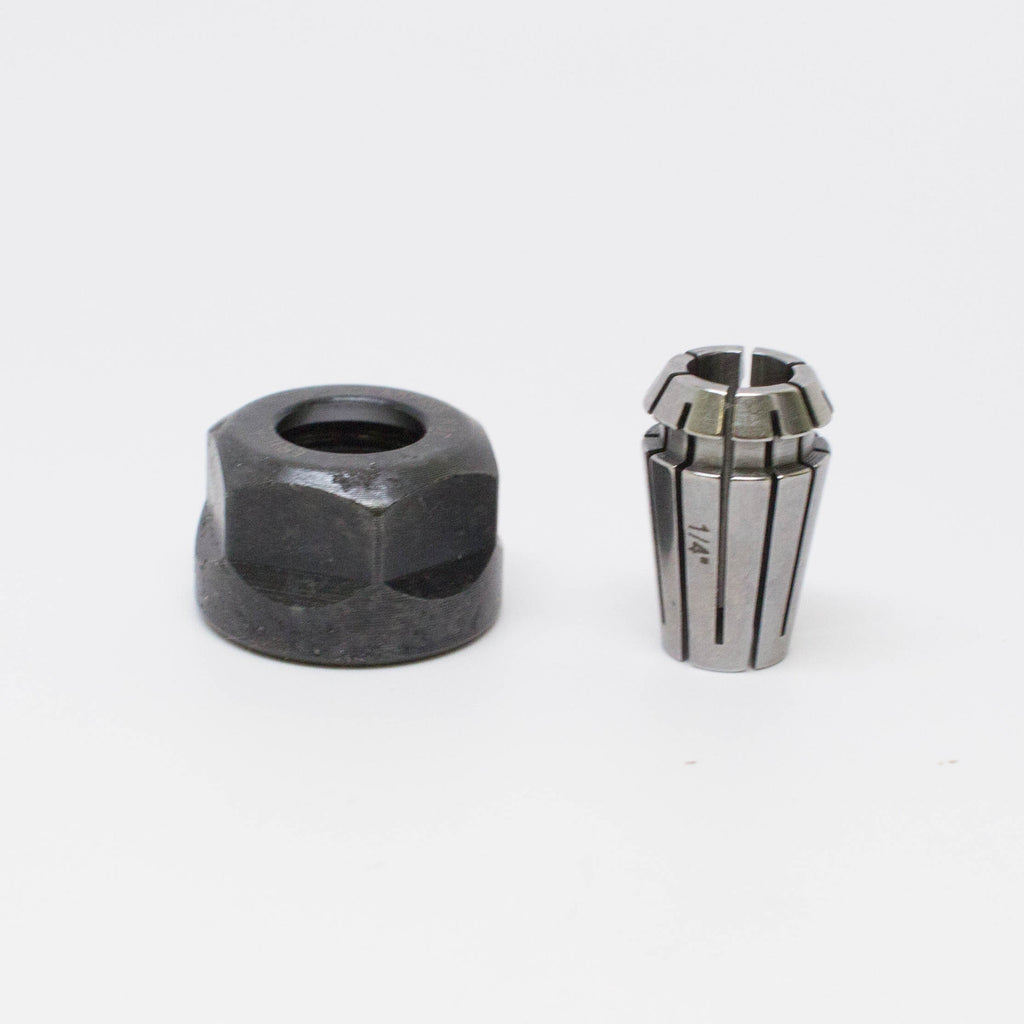
Changing a tool is a manual operation on the Nomad — there is no automatic tool changer — but it is quick: loosen the nut, swap the tool, snug it back, and let the machine re-probe the new tool’s length. That last step is what makes manual tool changes painless, and it is worth its own section.
2.5 Probing: tool length and work position
The single feature that most separates a pleasant desktop mill from a frustrating one is how it handles zeroing — telling the machine where the tool tip is and where the part is. The Nomad addresses this with two independent probes, and keeping them straight in one’s head is the key to trusting the machine.
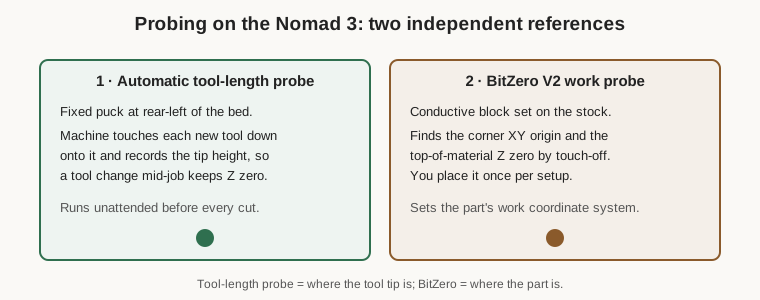
The first is the automatic tool-length probe — a fixed conductive puck mounted at the rear of the bed. Before a job, and again after any tool change, the machine drives the spinning-stopped tool tip down until it touches the puck and closes an electrical circuit, recording exactly how far the tip protrudes. Because the puck is at a fixed, known height, the machine can now keep the Z zero correct even though every tool sticks out of the collet by a slightly different amount. This is what makes multi-tool jobs practical: rough a pocket with one endmill, pause, swap to a finishing tool, and the machine re-measures and carries on at the correct depth with no manual re-zeroing.
The second is the BitZero V2, a work probe that ships with the machine. It is a precision conductive block the operator sets against a corner of the stock. Under software control, the machine touches the tool to the block in X, Y, and Z, and from those touch-offs computes the location of the part’s corner and the height of its top surface — the part’s work coordinate system, the origin from which the whole program is measured. Set the BitZero once at the start of a setup and the machine knows where the material is, to a repeatability far better than eyeballing a tool against a scribed line.
The clean division of labour is worth remembering: the fixed tool probe answers where is the tool tip, and the BitZero answers where is the part. Together they turn setup from the most error-prone step in hobby CNC into a couple of guided button presses.
2.6 The bed, fixturing, and workholding
The work sits on a bed inside the enclosure. The Nomad ships with an MDF wasteboard — a sacrificial flat sheet that the operator can screw or tape work to, and cut slightly into without harming the machine. For metal and for repeatable setups, Carbide and the community offer accessory fixturing: a threaded aluminium table or fixture plate with a grid of tapped holes, low-profile machinist vises sized for the envelope, and clamp sets. The universal fallback for flat stock is double-sided tape — a strip of it will hold a thin plate flat and immovable through a surprisingly aggressive cut, and the Nomad ships with tape for exactly this reason.
Workholding on a small mill is not an afterthought; it is often the deciding factor in whether a part succeeds. Cutting forces try to lift and shove the workpiece, and any movement ruins the part and can break the tool. The Nomad’s small envelope actually helps here — short parts held near a rigid bed are easy to clamp solidly — but the operator still has to think about it deliberately for every setup. Volume 3 returns to workholding in the context of the day-to-day workflow.
2.7 The work envelope and what it implies
The Nomad 3’s cutting area is about 8 inches in X and Y and 3 inches in Z — roughly 203 by 203 by 76 mm. The whole machine occupies a footprint of around 17.5 by 19 inches and stands about 17 inches tall, and it weighs on the order of 65 pounds, light enough for one determined person to reposition and small enough to live on a bench. It runs from an ordinary 110/220 V outlet at a couple of amps.
An 8-by-8-inch bed sounds small, and it is — that is the price of the rigidity and the enclosure. But it is well-matched to the machine’s purpose. The parts a light desktop mill should be making — brackets, panels, PCBs, jewelry, small mechanical components — nearly all fit inside a palm-sized envelope. Trying to make the envelope bigger would mean longer, more flexible axes and a bulkier machine, which would erode the very stiffness that lets it cut metal. The small work area is not a limitation the designers failed to overcome; it is the deliberate other side of the rigidity bargain.
2.8 Material capability, honestly stated
The Nomad’s material list runs from soft to hard, and the honest headline is aluminium yes, steel with care. Woods of every kind and plastics — ABS, acrylic, polycarbonate, Delrin, HDPE, PEEK, PVC — cut easily and quickly; they are well within the machine’s power and rigidity, and the enclosure earns its keep catching their dust and stringy swarf. Copper-clad PCB blanks are a natural fit and a signature use.
Among metals, aluminium is where the Nomad is genuinely at home — 6061 and similar alloys, plus brass and copper, mill cleanly with appropriate tooling, shallow passes, and a little air or mist to clear chips. This is the capability that justifies the whole machine. Steel is possible but is at the edge of the envelope: the spindle power and frame mass simply are not there for anything but very light, patient, shallow work on small features, and it is not what the machine is designed around. A maker who needs to routinely cut steel wants a heavier mill; a maker who wants clean aluminium parts on a quiet desktop wants exactly this one.
2.8.1 Setting accuracy expectations
A reasonable question is how accurate a part off the Nomad actually is, and the honest answer is: more than accurate enough for the parts it is meant to make, provided the operator does their part. The machine’s repeatability — its ability to return to the same commanded position — is good, thanks to the inductive homing, the anti-backlash lead-screw nuts, and the stiff rails. But the accuracy of a finished part depends on more than the machine: it depends on the workholding not moving, the stock being what the program assumes, the tool being sharp and running true in a clean collet, and the feeds and speeds being matched to the material so the tool is not deflecting under load. The Nomad gives a good, stiff, repeatable platform; turning that into a part that measures right is a collaboration between the machine and the operator. For the shop’s typical work — brackets, panels, enclosures, PCBs, jewelry — the machine is comfortably capable of holding the tolerances those parts need, which is the only test that matters.
Getting all of this right up front is the difference between a machine that delights and one that disappoints — and it sets up Volume 3, where the software and workflow turn these capabilities into actual finished parts.
Comments (0)