Prusa MK3S+ · Volume 1
Overview — What the MK3S+ Is, and Why It Became the Benchmark
1.1 A machine that earned its reputation
The Original Prusa i3 MK3S+ is a desktop fused deposition modeling (FDM) 3D printer — a machine that builds objects layer by layer by melting a plastic filament and laying it down along a path a computer worked out in advance. It is made by Prusa Research, the Czech company founded by Josef Průša, and for roughly the second half of the 2010s and well into the 2020s it was, by broad consensus, the printer that other printers were measured against. When reviewers reached for a phrase, it was usually some variant of “the one that just works.” That reputation is the reason this shop runs not one but two of them.
Both machines here are heavily modified, and the specifics of those modifications — the enclosures, the swapped parts, the network control, and the photographs of the owner’s actual hardware — are being documented over time. So these volumes take the sensible approach: they describe the base MK3S+ thoroughly and accurately from public information, so that when the modifications are covered they make sense against a clear picture of what they changed. The owner’s-build details live in their own volume, with clearly-marked slots left open for the parts and photos still to come.
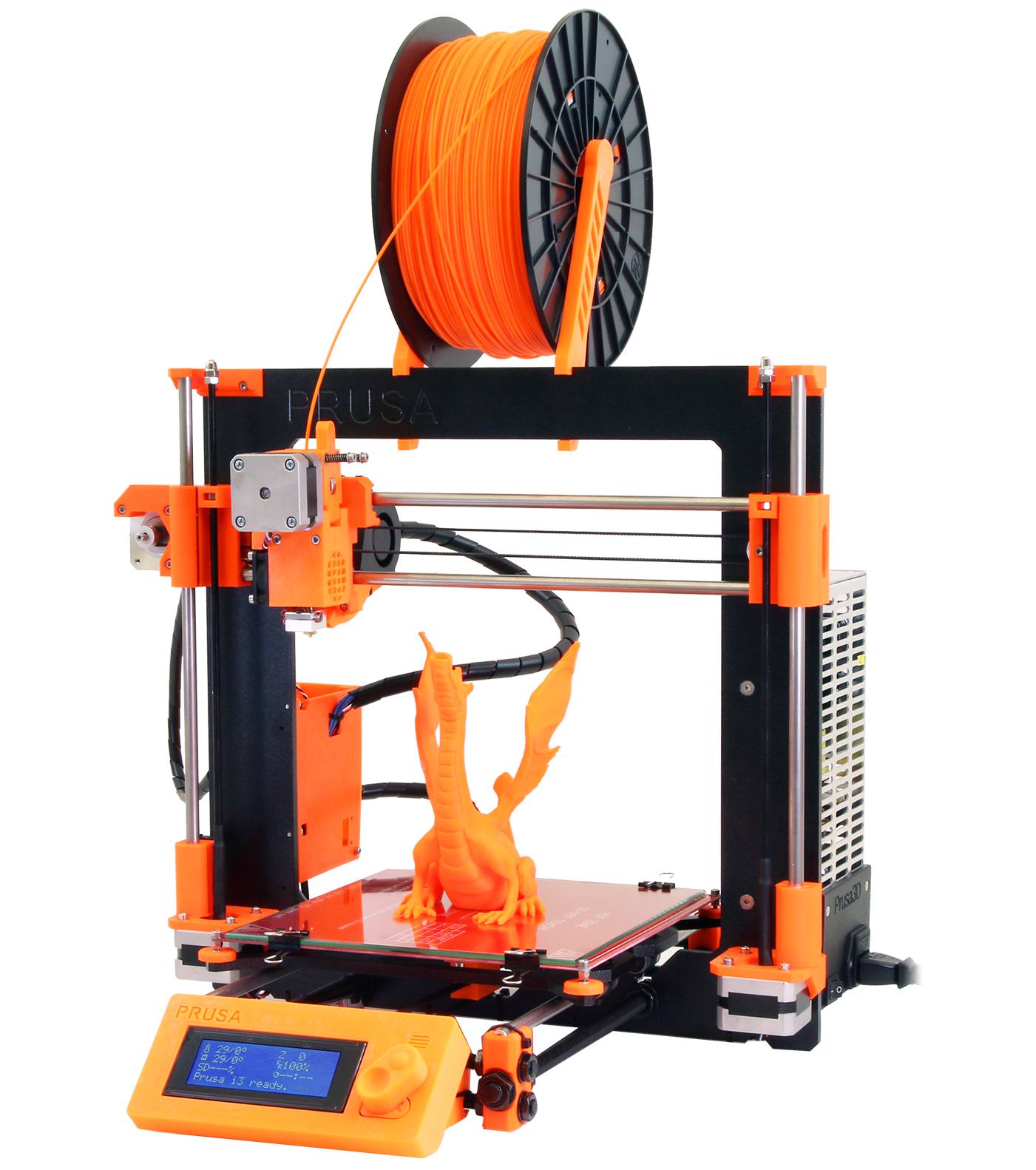
Before the anatomy and the modifications, it is worth being clear about what the MK3S+ actually is, where it came from, and why so many people — including this shop, twice over — settled on it as a dependable workhorse rather than a project to be endlessly babysat.
1.2 What “i3” and “FDM” actually mean
Two pieces of jargon appear on the box, and both are worth unpacking because everything else follows from them.
FDM — fused deposition modeling, sometimes called fused filament fabrication (FFF) to sidestep a trademark — is the most common 3D-printing process in the hobby world. A spool of thermoplastic filament, 1.75 mm in diameter on this machine, is pushed by a geared motor into a hotend: a small heated block that melts the plastic and squeezes it out through a fine nozzle, 0.4 mm across by default. The nozzle traces the outline and infill of one thin horizontal slice of the object, the plastic cools and solidifies almost immediately, and then either the nozzle or the object moves a fraction of a millimetre in the vertical direction and the next slice is drawn on top. Stack a few hundred or a few thousand of these layers and a solid object emerges. It is a simple idea executed with a great deal of quiet precision, and the quality of the result comes down to how accurately and repeatably the machine can move that nozzle and meter that plastic.
i3 is the name of the mechanical layout, and it is the third major iteration of Josef Průša’s take on the RepRap “Prusa Mendel” design (the “i” stands for iteration). An i3 is a Cartesian printer: it moves the nozzle in three straight, perpendicular axes — X (left-right), Y (front-back), and Z (up-down) — named after the Cartesian coordinate system. Specifically, it is a “bed-slinger” arrangement, a term the community uses affectionately and a little wearily: the print bed itself slides back and forth on the Y axis, carrying the object with it, while the nozzle moves left-right on the X axis and the whole X gantry climbs slowly up the Z axis on a pair of leadscrews. This layout is mechanically simple, cheap to build, easy to understand, and easy to repair — and it has one well-known consequence, the moving mass of the bed, that shapes how fast one can sensibly print. That trade-off gets a full treatment in the next volume.
The important takeaway is that the MK3S+ is deliberately conventional. It does nothing exotic. Its excellence comes not from a clever mechanism but from a very well-sorted execution of a well-understood one.
1.3 The RepRap lineage
The MK3S+ did not appear from nowhere. It sits at the mature end of one of the most important open-hardware projects of the century so far: RepRap.
RepRap — short for “replicating rapid prototyper” — began in 2005 as a project by Adrian Bowyer at the University of Bath, with a genuinely radical goal: a 3D printer that could print most of its own parts, and whose designs were released freely so anyone could build, improve, and redistribute them. The early RepRap machines (“Darwin,” then “Mendel”) were spidery contraptions of threaded rod, printed plastic brackets, and hobby electronics, assembled by enthusiasts who then shared their improvements back to the community. It was open source applied to hardware, and it worked: designs forked, competed, and cross-pollinated at a pace no single company could match.
Josef Průša was one of those early contributors. His Prusa Mendel simplified the Mendel design and made it far easier to build, and his subsequent Prusa i3, released around 2012, became the single most-copied 3D-printer design in history. Its clean single-frame layout was cheap to source, easy to assemble, and open for anyone to clone — and cloned it was, by the thousand, under a hundred different brand names. The generic “i3-style” printers that flooded the market for a decade are all descendants of that design.
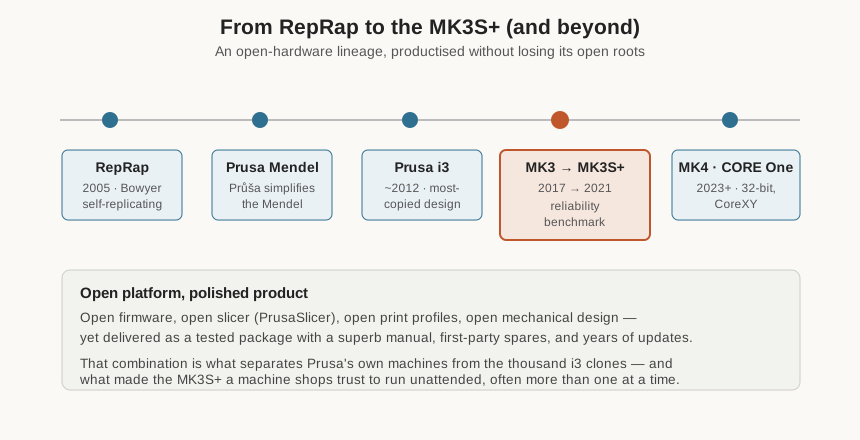
What separates Prusa Research’s own machines from the sea of clones is that Průša turned his open design into a product without abandoning its open roots. The firmware, the print profiles, the slicing software, and much of the mechanical design remain open source to this day; a MK3S+ owner can read the firmware, modify it, and reflash it. But the machine arrives as a coherent, tested, supported package — carefully selected components, a thick and genuinely good assembly manual, a lifetime of firmware updates, and a support operation behind it. That combination, open platform plus polished product, is much of why the MK3S+ became a benchmark rather than just another i3.
1.4 Why it became the reliability benchmark
Plenty of printers are cheaper than a Prusa. Several are faster. So it is worth being precise about what the MK3S+ actually earned its reputation on, because “reliability benchmark” is a specific and defensible claim, not marketing gloss.
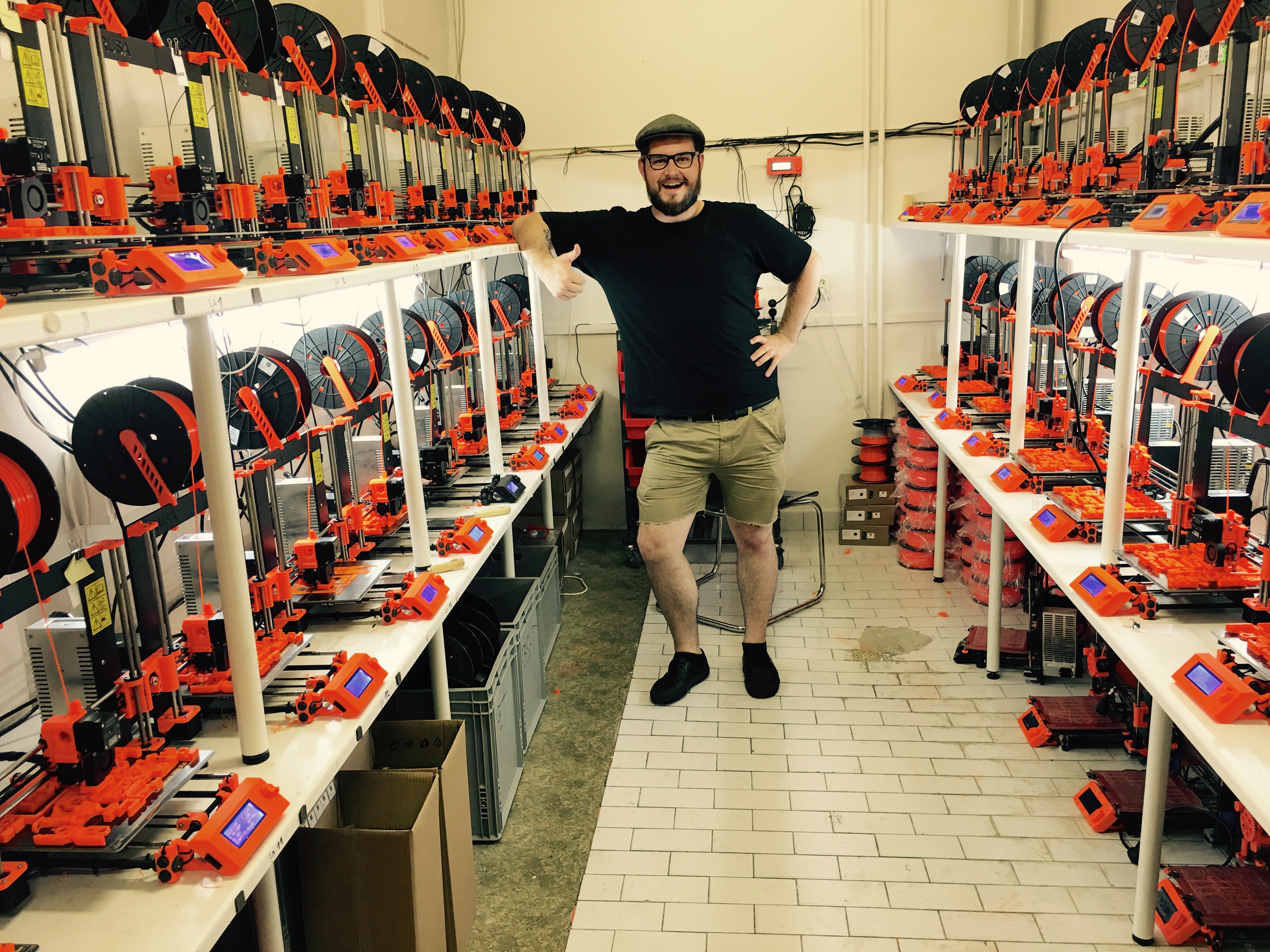
The first pillar is repeatability. A MK3S+ that is set up correctly tends to produce the same result on the hundredth print as on the first, and the same result as the identical machine on the next bench. This is exactly why print farms — walls of dozens or hundreds of identical printers running around the clock — were built on Prusa hardware; Prusa Research runs one of the largest such farms in the world to manufacture its own printers’ plastic parts. A machine you can trust to run unattended overnight, and to behave the same tomorrow, is worth more to a working shop than a machine that is occasionally spectacular and often fussy. It is also precisely why this shop runs two: a second identical machine doubles throughput and provides a known-good reference when something on the first one drifts.
The second pillar is a set of features aimed squarely at unattended reliability, most of which the cheaper clones lacked for years. The MK3-generation machines introduced, as standard, a filament runout sensor that pauses the print when the spool runs dry rather than spitting air for six hours; a power-panic feature that saves the print state on a mains failure so a job can resume after the power returns; crash detection, which uses the stepper drivers themselves to notice when an axis has hit an obstruction; and RPM-monitored fans that halt the print if cooling fails. Individually these are small. Together they mean the machine tends to stop safely rather than fail messily, and a print that would have been ruined is instead paused, recoverable, or cleanly aborted.
The third pillar is the ecosystem: an enormous, well-documented user community, first-party spare parts for essentially every component, a slicer (PrusaSlicer) developed in lockstep with the hardware and shipping tuned profiles, and years of continuous firmware improvement to a machine long after purchase. When something does go wrong, the answer is almost always a search away, and the fix is almost always a part one can actually buy. For a shop, that maintainability is itself a form of reliability.
1.5 The honest limitations
A benchmark is not the same as a perfect machine, and it is worth being candid about what the MK3S+ is not, because the modifications in a later volume are in part responses to these limits. It is not fast by the standards that arrived after it: the 8-bit controller and the bed-slinger’s moving mass together cap sensible print speeds well below what the input-shaped CoreXY machines of the 2020s achieve, and a big print is measured in hours, sometimes tens of hours. It has a modest build volume — roughly 250 by 210 by 210 millimetres — that suits the overwhelming majority of shop parts but rules out large single pieces. It is single-material out of the box, printing one colour and one plastic per job unless fitted with a multi-material add-on. And in stock form it is open to the room, which limits it with the warp-prone engineering plastics until it is enclosed.
None of these is a defect so much as a design choice, and each has a well-trodden answer — patience, splitting a part across the bed, a multi-material unit, an enclosure. The point of naming them is that the MK3S+‘s reputation rests not on being the best at any single metric but on being reliable, understandable, and fixable across all of them. For a shop, a machine that does a great many things dependably and can be understood completely is often more valuable than one that does a single thing spectacularly and remains a mystery. That is the trade the two units here represent.
1.6 The kit-versus-assembled question
Prusa sold the MK3S+ two ways, and the choice says something about the machine’s character. One could buy it fully assembled and tested, ready to print out of the box, or as a kit to build oneself over the better part of a day — historically at a meaningful discount, often several hundred dollars less.
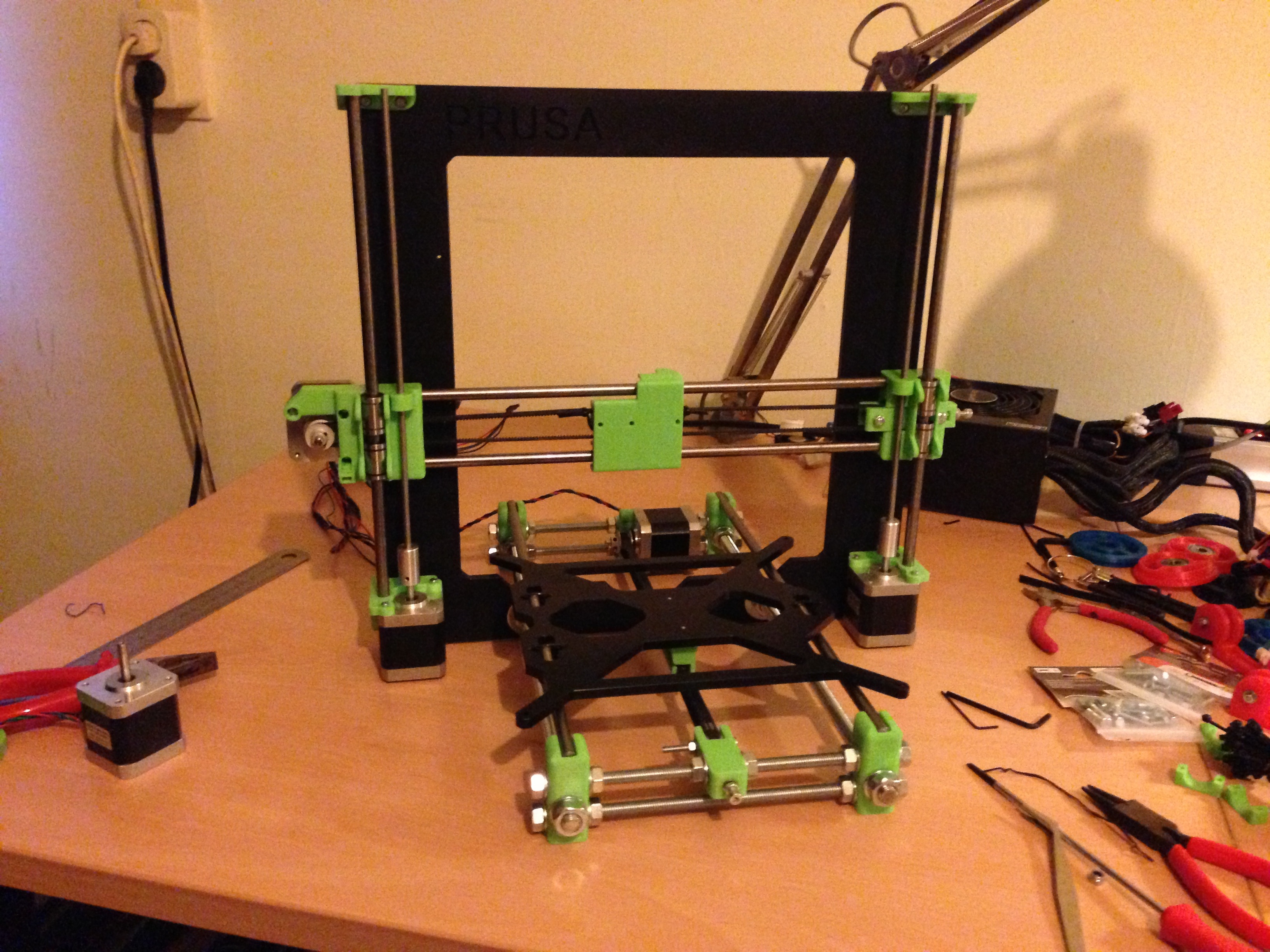
The kit is not a cynical cost-cutting exercise; it is a deliberate part of the philosophy. The assembly manual is genuinely excellent — clear, illustrated, patient, sprinkled with encouragement and the occasional bag of gummy bears in the box — and building the machine teaches the builder exactly how it works. Someone who has assembled their own MK3S+ knows where every belt, bearing, and connector is, has calibrated the first layer by hand, and is far better equipped to diagnose and repair it later. For a maker who intends to modify the machine anyway, the kit is arguably the better option, not merely the cheaper one: it removes any mystery about what is inside.
The assembled option exists for those who want a tool rather than a project, and it prints identically. Either way the buyer ends up with the same machine; the kit simply front-loads the education. In a shop that runs two heavily-modified units, the deep familiarity that comes from hands-on assembly is not incidental — it is the foundation that makes confident modification possible.
1.7 Where the MK3S+ sits in time
It is worth stating plainly, because it frames everything that follows: the MK3S+ is not Prusa’s newest machine. It is the mature final form of the MK3 line. The MK3 arrived in 2017; the MK3S refined the extruder and sensor in 2019; and the MK3S+, in 2021, was a further small-but-meaningful refinement — most visibly swapping the temperature-sensitive PINDA2 bed probe for the temperature-independent SuperPINDA, along with a revised filament sensor and improved printed extruder parts. It runs an 8-bit control board, the Einsy RAMBo, which is modest by modern standards but proven and quiet.
Prusa has since moved on. The MK4 (2023, later the MK4S) brought 32-bit electronics, a load-cell-based automatic first-layer calibration, faster input-shaper motion, and a colour touchscreen, and existing MK3S+ machines can be upgraded to it. More recently the CORE One moved the company to an enclosed CoreXY motion system, a different architecture entirely. The MK3S+ therefore represents a specific, well-understood, and — crucially — endlessly documented and modifiable point in that history. That maturity is a feature for a shop that values a machine it can fully understand, repair, and bend to its own purposes. Everything that made the MK3S+ the benchmark is still true of it; it has simply been joined by faster successors.
1.8 What the rest of these volumes cover
The remaining volumes go deep. The next dissects the machine mechanically and electronically: the i3 Cartesian layout and its bed-slinger consequences, the frame, the magnetic spring-steel bed and how the SuperPINDA maps its flatness, the Bondtech extruder and E3D-derived hotend, and the Einsy RAMBo board with its Trinamic stepper drivers that deliver both the quiet running and the crash detection. The modifications volume surveys the vast MK3S+ upgrade ecosystem accurately — enclosures, aftermarket frames, hotend and nozzle swaps, sheet choices, network control, and the upgrade path to the MK4 — while leaving clearly-marked slots for the two specific printers’ actual modifications and photographs. The workflow volume covers PrusaSlicer, the common materials and their needs, first-layer calibration, adhesion, failure modes, and routine maintenance. The final volume surveys what these two machines actually make in the shop, collects the specifications into one table, lists the consumables, and points to the best further reading.
Comments (0)